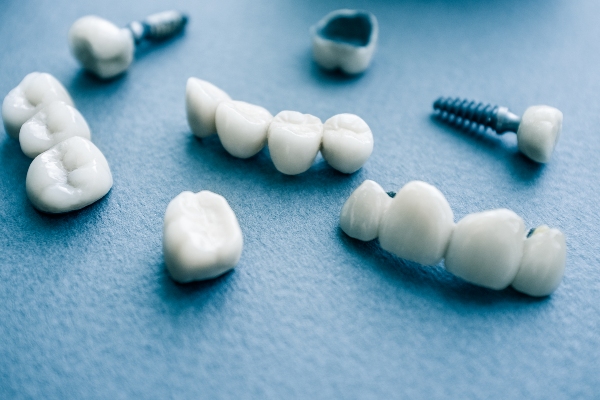
 A general dentist may use a dental crown for several reasons, from restoring decayed or damaged teeth to supporting teeth replacements. Just as there are many applications for crowns, there are also many types of them. Porcelain and porcelain-fused-to-metal (PFM) are among the most commonly recommended by dentists. Learning the key differences between these crowns can help you gain a better understanding of which to choose.
What are dental crowns?
Dental crowns get their name from how they restore teeth: They sit on top of the treated tooth like a crown, completely engulfing it. Thus, they are also often referred to as dental caps.
All types of dental crowns can restore the tooth's shape in this way. However, only some also take on the appearance of a natural tooth. For instance, metal crowns can restore teeth, but they will appear silver or gold in color. On the other hand, porcelain and PFM crowns are tooth-colored, providing a dental restoration that blends seamlessly.
Porcelain vs. PFM dental crowns
Many patients prefer a tooth-colored crown. A porcelain, or all-ceramic, crown is a popular choice because it most effectively mimics the shade and sheen of a natural tooth. Since porcelain crowns do not contain metal, they are a safe choice for patients with metal allergies.
When metal allergies are not an issue, patients are often drawn to PFM crowns. As their name suggests, PFM crowns have a metal center covered by a porcelain coating. These crowns provide the porcelain crown’s natural appearance and the metal crown’s durability. Unfortunately, the porcelain coating can wear over time, eventually revealing parts of the metal center.
When to opt for a porcelain crown
A porcelain crown is an effective option for restoring front teeth or supporting dental bridges meant to replace front teeth. Certain types of porcelain — such as zirconia dioxide, according to the Cleveland Clinic — are strong enough to withstand chewing force and restore premolars and molars. Thus, porcelain crowns are a highly customizable dental restoration perfect for patients with known metal allergies.
Patients who want a sturdier porcelain crown may consider a pressed ceramic crown. These crowns have a core composed of multiple layers of pressed ceramic, giving them additional biting and chewing power. They are often referred to as a non-metal alternative to PFM crowns.
When PFM crowns may be a better option
Porcelain-fused-to-metal crowns are the most durable tooth-colored crown type. As such, general dentists often recommend PFM crowns to patients without metal allergies who need to restore or replace a molar or premolar. These back teeth are mostly used for chewing and do not show when smiling, so chips in the porcelain coating are not of much cosmetic concern. However, these crowns are rarely used to restore front teeth due to the potential for chipping.
Get a firmer answer in an appointment
Not sure which dental crown is right for you? Our general dentist at Downtown Atlanta Dentistry can provide recommendations personalized to your or your child’s dental needs. Contact us today for an appointment.
Request an appointment or call Downtown Atlanta Dentistry at 404-999-1407 for an appointment in our Atlanta office.
Related Posts
Dental crowns are an effective solution for restoring damaged and decayed teeth. They protect the tooth from further damage while enhancing its appearance, blending in with the rest of your smile. However, it can be difficult to choose between the many types of crowns, such as porcelain and metal, as each of these materials has…
There are a variety of restorative treatments for damaged and decayed teeth. For instance, dental crowns and onlays can restore teeth that have damage that is too extensive for fillings to address. Understanding the basics of each can give you a better idea of which option a general dentist is likely to recommend and why.A…
A dental crown is one of the most common restorative dental procedures. It restores the form and function of a tooth affected by damage or decay. Whether due to decay, trauma, or wear and tear, a crown can restore the strength and appearance of your tooth through a fairly simple procedure.A dental crown is a…